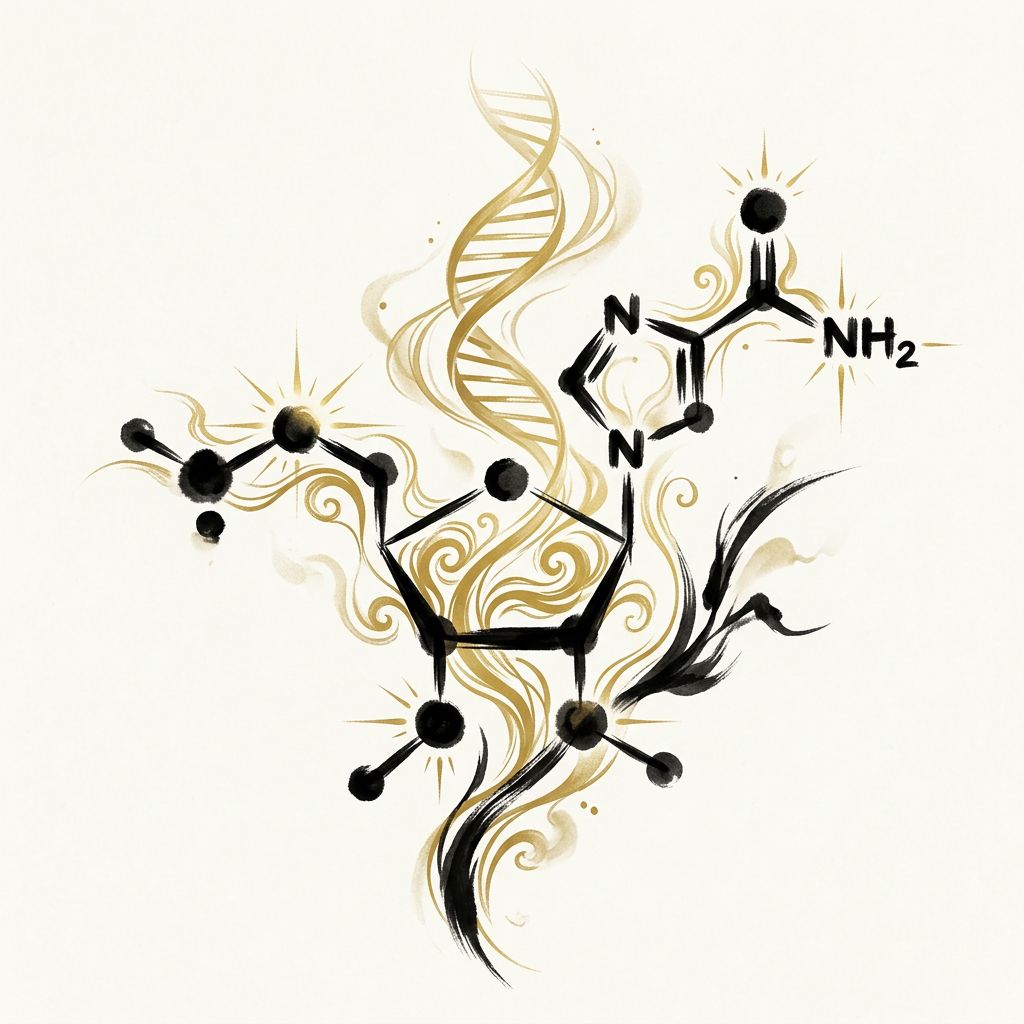
If you've spent any time reading about longevity or anti-aging science, you've probably come across NMN. It shows up in podcasts, supplement shelves, and headlines about Harvard researchers trying to "reverse aging." But strip away the hype, and there's a genuinely interesting molecule here — one that sits at the centre of how your cells produce energy and repair themselves.
So what is NMN, really? And why are serious scientists paying attention to it?
The Short Version: NMN Is Fuel for Your Cells
NMN (nicotinamide mononucleotide) is a naturally occurring molecule — a building block of DNA — that belongs to the vitamin B3 family. Your body already makes it in small amounts.
Its job? NMN is the raw material your cells use to make NAD+, a coenzyme that powers cellular energy production and DNA repair. Think of NAD+ as the fuel that keeps your cellular engine running. NMN is the most direct way to top up that fuel tank.
What makes NMN special compared to other NAD+ precursors is efficiency. Converting NMN into NAD+ takes just one enzymatic step — a single reaction through NMNAT enzymes. Other precursors, like niacin or NR, need two or three steps to get there. It's the difference between a direct flight and one with layovers.
Why NAD+ Matters (And Why It's Declining)
Here's the part that gets longevity researchers excited — and a little concerned.
Your body produces NAD+ through something called the salvage pathway, which recycles nicotinamide back into NAD+ in a continuous loop:
- Nicotinamide is converted to NMN by the enzyme NAMPT
- NMN is converted to NAD+ by NMNAT enzymes
- NAD+ is consumed by sirtuins, PARPs, and CD38
- Nicotinamide is released, and the cycle repeats
The bottleneck is step one. NAMPT activity declines as we age, which means your body makes less NMN, which means less NAD+, which means your cells gradually lose the fuel they need to function properly. Research suggests NAD+ levels can drop by up to 50% between ages 40 and 60.
Supplementing with NMN bypasses that bottleneck entirely. You're giving your cells direct access to the molecule they need, skipping the step that slows down with age.
Can't You Just Eat NMN-Rich Foods?
NMN does exist naturally in foods like edamame, broccoli, avocado, and cucumber — but in tiny amounts. You'd need to eat roughly 50-100 kg of broccoli to match a single 500 mg supplement dose. So no, the dietary route isn't going to cut it.
| Food Source | NMN Content (mg per 100g) |
|---|---|
| Edamame | 0.47–1.88 |
| Broccoli | 0.25–1.12 |
| Avocado | 0.36–1.60 |
| Cucumber (skin) | 0.56 |
| Cabbage | 0.0–0.90 |
| Tomato | 0.26–0.30 |
The Scientists Behind the NMN Story
Two researchers in particular have shaped how we think about NMN and aging.
Dr. Shin-ichiro Imai — The Pioneer
Dr. Imai at Washington University School of Medicine first identified NAMPT as the rate-limiting enzyme in NAD+ production back in 2004. His lab showed that giving NMN to aged mice reversed metabolic dysfunction — essentially making old mice look metabolically like younger ones. A 2011 paper in Cell Metabolism demonstrated improved glucose tolerance, lipid profiles, and physical activity in aged mice receiving NMN.
He's the one who figured out why NAD+ declines and proved that NMN could fix it — at least in mice.
Dr. David Sinclair — The Populariser
If Imai laid the scientific groundwork, David Sinclair brought it to the public. A genetics professor at Harvard Medical School, Sinclair's lab showed that NMN could restore blood vessel growth and improve endurance in aged mice. His 2019 book Lifespan turned NAD+ science into mainstream conversation.
Sinclair takes 1 gram of NMN daily as part of his personal longevity protocol — though he's always careful to say this is a personal choice, not a clinical recommendation.
For more on his protocol and research: What Does David Sinclair Say About NMN?
Key Milestones in NMN Research
- 2004: Imai lab identifies NAMPT as the key enzyme in NAD+ production
- 2011: NMN reverses metabolic decline in aged mice
- 2013: Sinclair lab shows NMN restores mitochondrial function in aged mice
- 2018: First small human NMN safety trial in Japan
- 2021: Washington University trial shows NMN improves insulin sensitivity in prediabetic women (published in Science)
- 2022: Multiple randomised controlled human trials confirm safety and NAD+ elevation
- 2023–2025: Larger, longer-duration human trials begin reporting results
What Happens When You Take NMN
Here's the journey from capsule to cellular effect:
It Gets Absorbed — Possibly Through a Dedicated Transporter
NMN is absorbed through the gut. A 2019 study in Nature Metabolism identified a specific transporter protein called Slc12a8 that appears to shuttle NMN directly into cells without breaking it down first. This is still debated in the scientific community, but if confirmed, it would mean NMN has a unique fast-track into your cells.
It Converts to NAD+ Quickly
Once inside your cells, NMN becomes NAD+ rapidly through NMNAT enzymes. Human studies show blood NAD+ levels rise significantly within hours of the first dose, with peak effects at about 14 days of consistent use.
It Reaches Multiple Tissues
Unlike some NAD+ precursors that mainly affect the liver, NMN appears to distribute broadly. A 2024 study in Cell Metabolism found that NMN raised NAD+ levels in muscle, brain, and fat tissue — suggesting benefits across your whole body, not just one organ.
Then NAD+ Gets to Work
With restored NAD+ levels, three key pathways fire up:
Sirtuin activation — SIRT1-7 are proteins that regulate gene expression, DNA repair, and metabolism. They need NAD+ to function. More NAD+ means your cellular maintenance crew can actually do its job.
DNA repair — PARPs are repair enzymes that fix DNA strand breaks, and they consume NAD+ every time they work. Adequate NAD+ keeps your repair machinery fuelled.
Mitochondrial function — NAD+ is essential for the electron transport chain in your mitochondria. More NAD+ means more efficient energy production. It's that simple.
What Does the Human Evidence Actually Show?
This is where we need to be honest about what we know and what we're still figuring out.
NAD+ Levels — Confirmed
This one's settled. A multicenter, double-blind trial published in GeroScience tested 300-900 mg of NMN daily in healthy middle-aged adults and found blood NAD+ roughly doubled within 14 days. Multiple other trials confirm this.
Physical Performance — Promising
A systematic review found improvements in physical performance across multiple trials. One study in amateur runners showed improved aerobic capacity. Another showed improved walking speed and grip strength in men over 65 after 12 weeks of 250 mg daily NMN.
Insulin Sensitivity — A Standout Finding
The Washington University trial — published in Science, which doesn't publish minor findings — showed that just 250 mg of NMN daily improved muscle insulin sensitivity by about 25% in postmenopausal prediabetic women after 10 weeks. This is one of the most compelling human results so far.
Sleep — Early but Interesting
A Japanese trial found that 250 mg NMN daily reduced drowsiness and improved sleep quality in adults over 65 when taken in the afternoon.
What's Still Unproven
Here's the honest part: a 2024 meta-analysis in Critical Reviews in Food Science and Nutrition found that while NMN reliably raises NAD+, many clinical outcomes — fasting glucose, lipid profiles, body composition — weren't significantly different between NMN and placebo groups across pooled studies.
NMN consistently raises NAD+, but we're still building the evidence for exactly how that translates into measurable health outcomes in humans. The science is promising, not finished.
The Different Ways to Take NMN
Capsules are the most common and convenient — pre-measured doses, protected from moisture, easy to travel with. Quality products use acid-resistant capsules.
Sublingual powder or tablets dissolve under the tongue for potentially faster absorption, though direct comparisons with capsules are limited.
Bulk powder is the cheapest option per milligram but requires a scale for accuracy and is more vulnerable to degradation.
Liposomal NMN wraps the molecule in fat to enhance absorption. Some manufacturers claim better bioavailability, but independent evidence is still developing.
Is NMN Safe?
The safety data is reassuring:
- Doses up to 1,200 mg per day tested without serious adverse effects
- Most common side effect is mild digestive discomfort that typically resolves in the first few days
- No significant changes in liver function, kidney function, or blood chemistry in clinical trials
- Long-term data beyond 12 months is still limited — most trials lasted 8-12 weeks
For a complete breakdown: Are NMN Supplements Safe? Side Effects and What the Research Says
The Regulatory Situation
NMN's regulatory status is messy. In 2022, the FDA said NMN couldn't be sold as a dietary supplement because it was being investigated as a new drug. But enforcement has been minimal, NMN remains widely available, and several industry groups have challenged the determination. In most international markets — Australia, the EU, Japan — NMN is sold without restriction.
How Does NMN Compare to Other NAD+ Boosters?
| Feature | NMN | NR (Nicotinamide Riboside) | Niacin (Vitamin B3) | NAD+ IV Therapy |
|---|---|---|---|---|
| Conversion steps to NAD+ | 1 | 2 | 3+ | 0 (direct) |
| Tissue distribution | Broad (muscle, brain, fat) | Primarily liver | Broad | Systemic |
| Flushing side effect | No | No | Yes (common) | No |
| FDA GRAS status | No | Yes | Yes | N/A |
| Cost per month | $30-80 | $40-90 | $5-15 | $250-1,000+ per session |
| Convenience | Daily capsule | Daily capsule | Daily capsule | Clinic visit required |
NMN's edge is its single-step conversion and broad tissue distribution. NR has a longer track record and GRAS status. Niacin is cheap but causes flushing. NAD+ IV gets there directly but is expensive and impractical for regular use.
For the full comparison: NMN vs NR: Which NAD+ Precursor Is Better for Anti-Aging?
Choosing a Quality NMN Supplement
The NMN market has grown fast, and not every product delivers what it promises. Here's what matters:
Purity — Look for 99%+ purity verified by a third-party Certificate of Analysis (COA). Anything below 98% may contain significant impurities.
Third-party testing — Independent labs like NSF, USP, or Eurofins should confirm purity, potency, and absence of contaminants.
Stability — NMN degrades with heat, moisture, and light. Quality products use opaque bottles, desiccant packets, and acid-resistant capsules.
Dosage — Clinical trials have used 250-900 mg daily. 500 mg is the most common starting recommendation based on the balance of efficacy data and cost.
For our detailed buyer's guide: What Are the Best NMN Supplements in 2026?
Worth Stacking With
Some formulations add complementary compounds:
- Trans-resveratrol — Activates SIRT1 while NMN provides the NAD+ fuel sirtuins need (learn about this stack)
- TMG (trimethylglycine) — Supports methylation balance, since NAD+ metabolism increases demand for methyl donors
- BioPerine (black pepper extract) — Enhances absorption of multiple compounds
Why We Built the NAD+ Elixir Around NMN
At Dan Alchemy, we spent a long time studying this research before formulating anything. Our NAD+ Elixir combines 500 mg of pharmaceutical-grade NMN with trans-resveratrol, TMG, and black pepper extract — the same compounds that keep appearing in the longevity research as complementary to each other. Every batch gets independently tested, and we publish the Certificates of Analysis because we think you should know exactly what you're taking.
This article is for informational purposes only and does not constitute medical advice. Consult your healthcare provider before starting any supplement regimen.