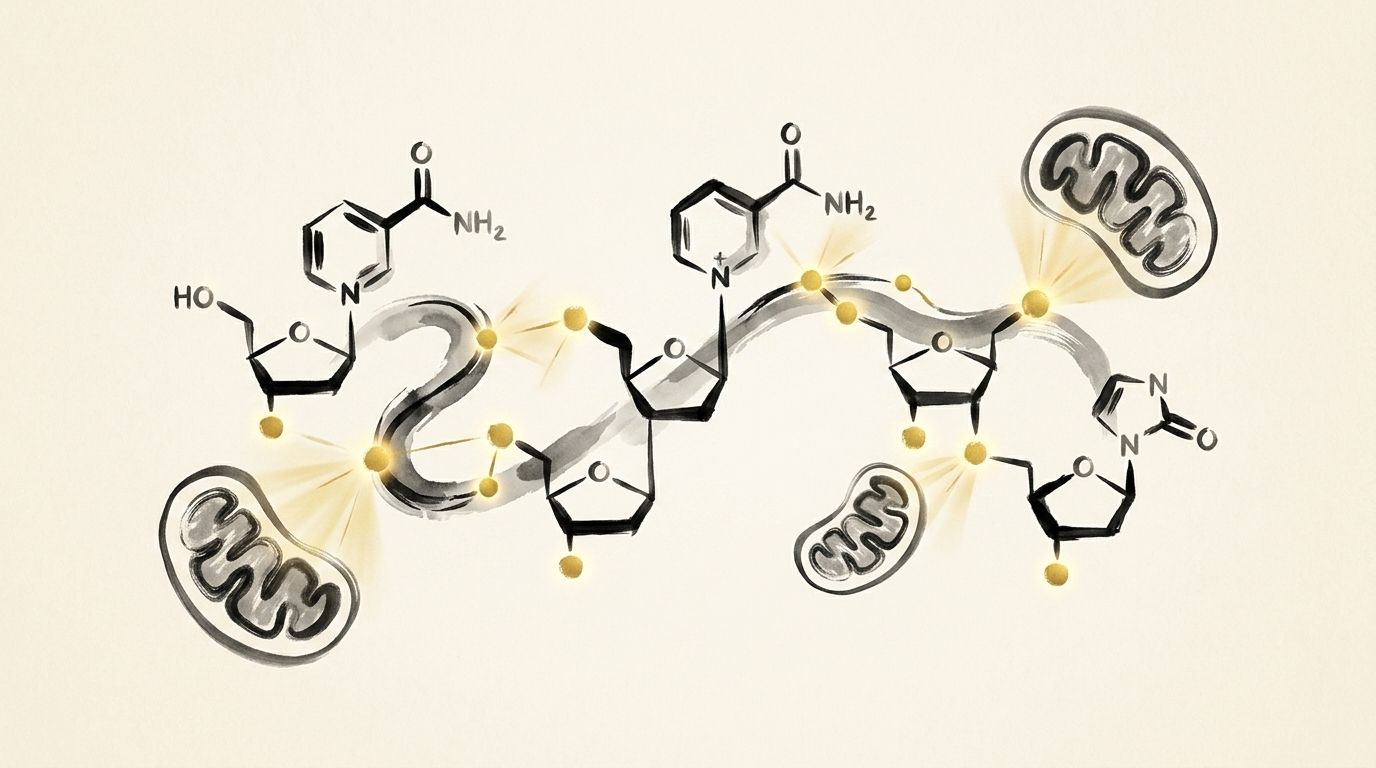
If you've started researching how to raise your NAD+ levels, you've probably hit a wall of confusing terminology — NAD+ boosters, precursors, NMN, NR, niacin, NADH. And if you're in Australia, the regulatory landscape adds another layer of complexity. Some of these ingredients are TGA-approved. Others aren't. And despite what some brands imply, you can't actually take NAD+ directly as an oral supplement in any meaningful way.
This guide cuts through the noise. We'll explain what NAD+ boosters really are, compare the three main precursors head-to-head, cover what the TGA actually says, and help you choose the right option.
What Is an NAD+ Booster Supplement?
An NAD+ booster is any supplement designed to increase your body's levels of NAD+ (nicotinamide adenine dinucleotide) — the coenzyme present in every living cell that drives energy production, DNA repair, and cellular ageing. If you need a deeper primer on NAD+ itself, our full NAD+ explainer is worth reading first.
Here's the critical point most marketing glosses over: you don't actually take NAD+ itself. NAD+ is a large, charged molecule that gets broken down in your digestive system before it can reach your cells intact. This is why oral NAD+ and NADH supplements don't work well — and why Australia's TGA has not approved NAD+ or NADH as listed medicine ingredients.
Instead, effective NAD+ boosters contain precursors — smaller molecules that survive digestion and that your body then converts into NAD+ through its natural biosynthesis pathways. The three main precursors are:
- NMN (nicotinamide mononucleotide) — one enzymatic step from NAD+
- NR (nicotinamide riboside) — two enzymatic steps from NAD+
- Niacin / nicotinic acid (vitamin B3) — multiple steps from NAD+, via the Preiss-Handler pathway
Each takes a different route to the same destination, and those routes matter more than you might think.
Why NAD+ Declines With Age (and Why It Matters)
Before comparing precursors, it helps to understand why NAD+ boosting is worth considering in the first place.
Research published in Trends in Cell Biology shows that NAD+ levels can decline by up to 50% between ages 40 and 60. That's not a gradual, barely noticeable slide — it's a steep drop that coincides with many hallmarks of ageing.
NAD+ fuels three families of enzymes that are critical to cellular health:
- Sirtuins (SIRT1-7) — proteins that regulate DNA repair, gene expression, and inflammation
- PARPs — enzymes that detect and fix DNA strand breaks
- CD38 — an immune signalling enzyme whose activity actually increases with age, consuming more NAD+ at precisely the time your body is producing less
As NAD+ drops, these enzyme systems compete for a shrinking pool. DNA repair slows. Mitochondrial function deteriorates. Inflammation increases. The downstream effects touch virtually every system — from energy levels and cognitive function to metabolic health and muscle recovery.
This is why NAD+ restoration has become one of the most actively researched strategies in longevity science, and why supplements targeting this pathway have exploded in popularity. For a deeper look at what the research shows, see our guide to NMN benefits.
The Three Main NAD+ Precursors Compared
Not all NAD+ boosters are created equal. The precursor your supplement contains determines how efficiently your body can convert it into usable NAD+, what side effects you might experience, and — in Australia — whether the product can even be legally sold as a listed medicine.
NMN (Nicotinamide Mononucleotide)
NMN is the most direct oral precursor to NAD+. It requires a single enzymatic step: the enzyme NMNAT attaches an adenylyl group to NMN, producing NAD+ directly. One step. No detours.
Human clinical trials have demonstrated that NMN supplementation at doses of 250 mg to 1,200 mg per day significantly raises circulating NAD+ levels — with some studies showing a roughly twofold increase within 14 days. Importantly, NMN has shown meaningful results even at the lower end of that dose range (250 mg), suggesting strong bioavailability.
In Australia, NMN is approved by the TGA as a permitted ingredient in listed medicines. This means Australian NMN supplements can carry an AUST L number — a meaningful quality and regulatory assurance.
NR (Nicotinamide Riboside)
NR is one step further back in the biosynthesis pathway. It must first be phosphorylated into NMN by NR kinase enzymes (NRK1/NRK2), and then that NMN is converted into NAD+ by NMNAT. Two enzymatic steps instead of one.
NR has a solid body of clinical evidence. A 2025 head-to-head trial found that NR and NMN raised NAD+ by comparable amounts at 1 gram per day. NR also holds FDA GRAS (Generally Recognised As Safe) status in the United States. However, the strongest NR results tend to come from studies using higher doses (500-1,000 mg), while NMN has shown efficacy at lower doses.
In Australia, NR is available but is typically sold as a food-type supplement rather than as a TGA-listed medicine. For a detailed breakdown of how these two precursors stack up, see our NMN vs NR comparison.
Niacin (Nicotinic Acid / Vitamin B3)
Niacin is the oldest and cheapest NAD+ precursor, and it does raise NAD+ levels — but through a longer, less direct route called the Preiss-Handler pathway. This involves multiple enzymatic conversions, and the process is significantly less efficient than the NMN or NR pathways.
The major drawback of niacin is flushing: a harmless but uncomfortable skin reddening, warmth, and tingling that occurs at the doses needed to meaningfully raise NAD+ (typically 500 mg and above). Extended-release formulations reduce flushing but have been associated with liver stress at high doses.
Niacin is widely available and inexpensive, but most people looking specifically for NAD+ restoration find the side effect profile and lower conversion efficiency unacceptable compared to NMN or NR.
NAD+ Precursor Comparison Table
| Feature | NMN | NR | Niacin (Nicotinic Acid) |
|---|---|---|---|
| Steps to NAD+ | 1 (NMNAT) | 2 (NRK then NMNAT) | 3+ (Preiss-Handler pathway) |
| Effective dose range | 250 - 1,200 mg/day | 500 - 1,000 mg/day | 500 - 2,000 mg/day |
| NAD+ increase (14 days) | ~2x at 1 g/day | ~2x at 1 g/day | Modest at comparable doses |
| Flushing side effect | No | No | Yes (significant) |
| TGA status (Australia) | Approved (AUST L eligible) | Food supplement | Approved (as vitamin B3) |
| FDA GRAS status (US) | No | Yes | Yes |
| Typical monthly cost (AU) | $40 - $80 | $50 - $90 | $5 - $15 |
| Best suited for | NAD+ optimisation at lower doses | Those wanting FDA GRAS assurance | Budget-conscious, flushing-tolerant |
The TGA Regulatory Landscape in Australia
If you're buying NAD+ booster supplements in Australia, the regulatory picture is something you need to understand — because it directly affects what's legally available to you and what quality assurances you're getting.
What IS approved:
- NMN is an approved ingredient for TGA-listed medicines. Products containing NMN can carry an AUST L number, which means they've been assessed for quality, safety, and manufacturing standards.
- Niacin (nicotinic acid and nicotinamide) is approved as vitamin B3 — a long-established nutrient.
What is NOT approved:
- NAD+ itself is not approved as a listed medicine ingredient by the TGA.
- NADH (the reduced form of NAD+) is also not approved as a listed medicine ingredient.
This distinction matters. Some international brands market "NAD+ supplements" or "NADH supplements" that cannot legally be sold as listed medicines in Australia. If you see a product claiming to contain NAD+ or NADH without an AUST L number, exercise caution — it may not have undergone TGA assessment.
The practical takeaway: in Australia, the most regulated and evidence-supported route to boosting NAD+ is through NMN supplementation with a TGA-listed product.
What to Look for When Buying an NAD+ Booster
With dozens of products on the market — from Chemist Warehouse shelves to online stores — here's how to separate quality from hype:
1. Precursor Type
Choose NMN or NR based on your priorities. NMN offers one-step conversion and TGA approval in Australia. NR has a solid evidence base and FDA GRAS status. Avoid products containing only NAD+ or NADH for oral use — the science doesn't support meaningful oral absorption.
2. Dosage
Look for products providing at least 250 mg of NMN per serve or 300 mg of NR per serve. Clinical trials showing meaningful NAD+ elevation start at these thresholds. Products with lower amounts per serve may not deliver a physiologically relevant dose.
3. Purity and Third-Party Testing
Quality NMN should be 98%+ pure, verified by independent Certificate of Analysis (CoA). Look for brands that publish their CoA or offer it on request. Enzymatic (biocatalytic) production methods generally yield higher purity than chemical synthesis.
4. Delivery Format
Capsules are the most common and well-studied format. Sublingual (under-the-tongue) powders may offer faster absorption by bypassing first-pass metabolism, though clinical data specifically on sublingual NMN is still limited. Liposomal formulations claim enhanced bioavailability but lack strong comparative human data as of 2026.
5. Regulatory Compliance
For Australian buyers, an AUST L number on the label confirms TGA listing. This isn't just a formality — it means the product, its ingredients, and its manufacturing facility have been assessed against Australian standards.
6. Complementary Ingredients
Some NAD+ boosters include additional compounds like resveratrol or TMG (trimethylglycine). Resveratrol may activate sirtuins — the same enzymes that NAD+ fuels — creating a potentially synergistic effect. TMG acts as a methyl donor, which some researchers suggest may support the methylation demands of increased NAD+ metabolism. Neither is essential, but they can add value in a well-formulated product.
How to Maximise the Benefits of NAD+ Supplementation
Taking a supplement is only part of the equation. Research suggests several lifestyle factors work synergistically with NAD+ precursors:
- Exercise — Physical activity activates AMPK and NAMPT, enzymes involved in NAD+ biosynthesis. Regular exercise may amplify the effects of supplementation.
- Caloric awareness — Overeating increases CD38 activity, which consumes NAD+. Maintaining a healthy caloric balance helps preserve your NAD+ pool.
- Sleep quality — NAD+ levels follow circadian rhythms. Disrupted sleep patterns can impair NAD+ cycling. Most people take their NAD+ booster in the morning to align with natural metabolic rhythms.
- Limit excessive alcohol — Alcohol metabolism directly depletes NAD+ by converting it to NADH during the detoxification process.
The Bottom Line: Which NAD+ Booster Should You Choose?
For most Australians looking to support their NAD+ levels, NMN is the strongest all-round option in 2026. It offers the most direct conversion pathway (one enzymatic step), has demonstrated clinical efficacy at accessible doses, and is the only NAD+ precursor with TGA approval as a listed medicine ingredient in Australia.
NR is a reasonable alternative — particularly if you prefer a product with FDA GRAS recognition or have a specific reason to choose it. Both precursors raise NAD+ effectively.
Niacin works but is best suited for people on a tight budget who can tolerate flushing. It's not ideal for targeted NAD+ optimisation.
What you should avoid: oral supplements containing NAD+ or NADH directly. The science doesn't support meaningful absorption through this route, and these ingredients lack TGA approval in Australia.
If you're ready to start, Dan Alchemy's NMN supplements are TGA-listed, third-party tested for purity, and formulated at clinically relevant doses. Browse our NMN range to find the right option for your goals.
This article is for informational purposes only and does not constitute medical advice. Consult a qualified healthcare professional before starting any new supplement regimen.